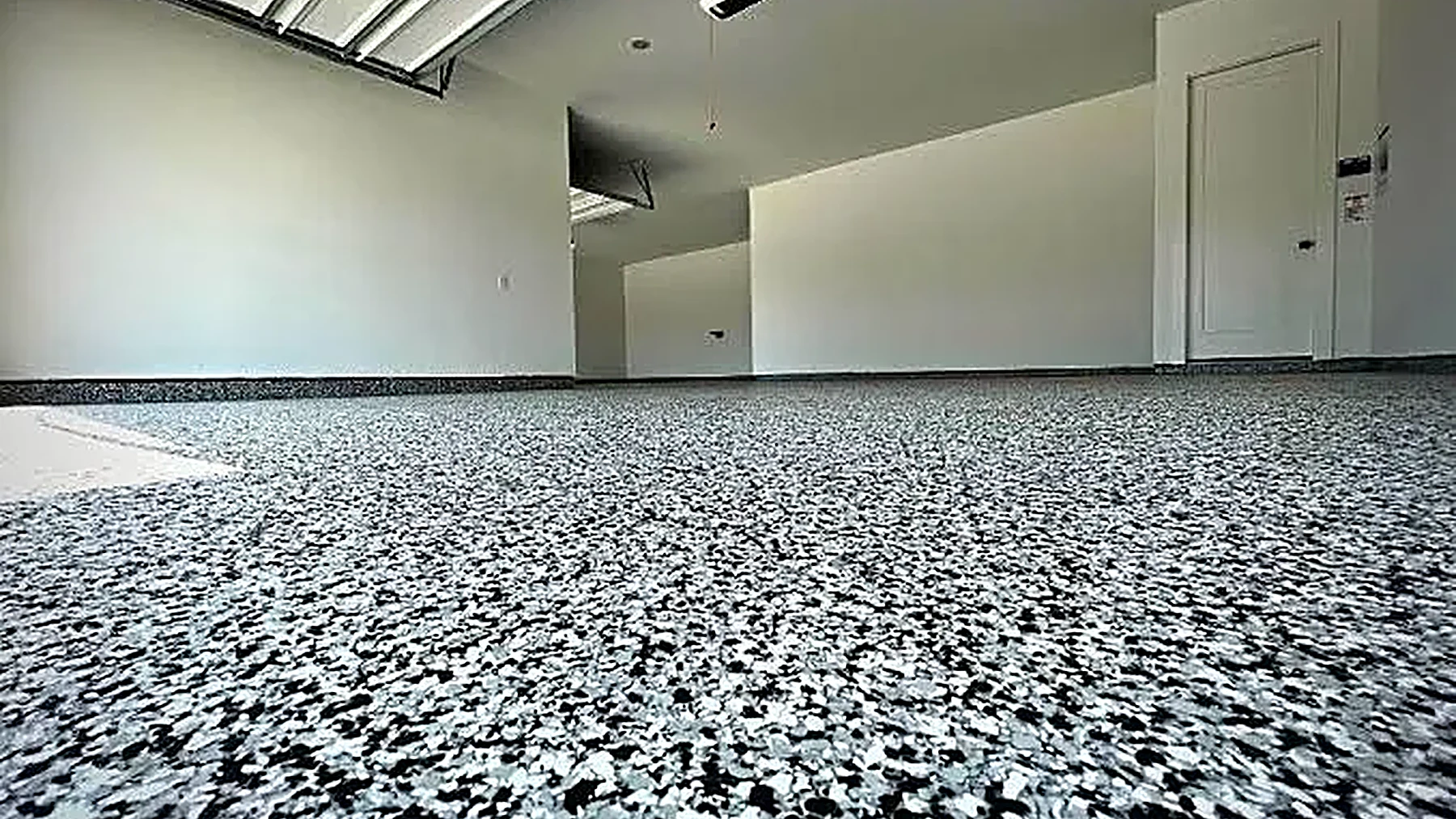
When people ask us why one garage floor coating lasts twenty years and another peels in two, the answer almost always comes down to a step most homeowners never see: the surface prep. Before a single drop of coating goes down, the concrete has to be opened up so the coating can grip it, and how that is done, diamond grinding versus acid-etching, largely determines whether your Boise floor lasts decades or fails fast. Here is what these two methods actually do, why the difference matters so much in our climate, and what the DIY kits get wrong.
A coating does not stick to concrete by magic; it bonds mechanically to the microscopic texture of the surface. Bare, cured concrete is often too smooth, sealed, or contaminated with oil and dust for a coating to grab. Prep is the process of profiling the slab, roughening and cleaning it to create the ideal surface for adhesion. Get this right and the coating fuses to the concrete and stays put through years of abuse. Get it wrong and even the best product in the world will eventually let go. That is why prep, not the coating you can see, is where a floor's fate is truly sealed.
Diamond grinding uses industrial machines with diamond-segmented discs to mechanically abrade the top layer of the concrete, removing old coatings, sealers, and contaminants while creating a consistent, uniform profile across the whole slab. It works on any concrete, including the dense, hard-troweled slabs and sealed floors that acid struggles with, and it produces exactly the texture professional coatings are engineered to bond to. The result is a clean, open, uniform surface that gives the coating maximum grip. It is more labor and equipment than etching, which is precisely why it delivers a far more reliable, longer-lasting bond.
Acid-etching uses an acidic solution, typically what comes in DIY kits, to chemically react with and roughen the concrete surface. It is cheap and requires no special equipment, which is its whole appeal. But its results are inconsistent: it often fails to adequately profile dense or troweled slabs, it does not remove oils or existing sealers, and if the floor is not perfectly neutralized and rinsed afterward, acid residue is left behind that actively undermines the coating bond. On the wrong slab, etching creates a surface that looks ready but gives the coating little to hold. It is the single most common reason DIY floors fail.
Our climate makes a strong bond non-negotiable. Freeze-thaw cycles flex the slab, magnesium-chloride deicer and salt attack the coating edges, and hot tires pulling into a cold Boise garage try to peel it up through hot-tire pickup. A coating bonded to a properly ground slab resists all of that because it is genuinely locked into the concrete. A coating over an etched, weakly profiled floor is exactly what these forces find and lift first. In a place with real winters, the extra step of grinding is not optional if you want the floor to last.
Beyond profiling, grinding lets us address the slab's real condition. We can grind down high spots, open up cracks and spalls for proper repair, and remove old failed coatings that etching would simply seal beneath a new layer. This means the coating goes over concrete that is not just profiled but actually sound. Acid poured on a floor cannot repair damage or remove a previous coating, so it papers over problems that resurface later. Proper mechanical prep is comprehensive in a way a chemical wash never can be.
Across the industry, mechanical prep like diamond grinding, and shot blasting for larger commercial jobs, is the recognized standard for achieving a proper concrete surface profile before coating. Organizations such as the International Concrete Repair Institute define the surface profiles coatings require, and those profiles come from grinding, not from a jug of acid. When a contractor grinds your floor, they are following the standard that gives coatings their engineered lifespan. It is a clear signal you are getting a job built to last rather than a quick shortcut.
Prep is also where you can spot a cut-rate bid. If a quote is suspiciously cheap, ask how the floor will be prepped, because skimping on grinding is the easiest way to lower a price and the surest way to end up with a floor that fails. A proper grind takes time, equipment, and dust containment, and it is a real part of the cost, but it is the part that makes everything above it worthwhile. Paying for grinding is paying for the years the floor will actually last.
It helps to know what real preparation looks like so you can recognize it, or its absence, in your own garage. A professional crew arrives with walk-behind grinders fitted to dust-collection vacuums, so the process is nearly dust-free rather than coating your home and belongings in concrete powder. They grind the entire slab to an even profile, then chase down cracks, joints, and any spalled or pitted areas and repair them with proper patching compounds that bond to the freshly ground concrete. Oil-stained spots get extra attention, since contamination is a classic bond-killer in a working Boise garage. Only after the floor is ground, repaired, vacuumed clean, and confirmed dry does any coating go down. Compare that to the DIY routine of pouring acid from a jug, scrubbing, rinsing with a garden hose, and hoping the floor dries evenly, and it becomes obvious why the two approaches produce such different lifespans. The visible coating might look similar on day one, but the foundation underneath, built during those unglamorous hours of grinding and repair, is what determines whether your floor is still flawless a decade later or peeling by spring.
Grinding versus etching is not a minor technical detail, it is the difference between a Boise garage floor that lasts decades and one that peels in a season or two. Diamond grinding creates the sound, uniform, contaminant-free profile a coating needs to bond for the long haul, especially against our freeze-thaw winters, while acid-etching is the corner the DIY kits cut. Insist on proper mechanical prep, and reach out and we will show you how we grind every floor for a bond that goes the distance.
For a coating meant to last, yes. Diamond grinding mechanically opens the concrete to a consistent, ideal profile that a coating can grip, and it works on dense or sealed slabs where acid barely does anything. Acid-etching is cheaper and what the DIY kits include, but it gives an inconsistent, weaker profile and leaves residue that can undermine the bond. Grinding is the professional standard here, and it is a big reason our floors outlast box-store ones.
Etching is exactly where those kits fall short. Acid-etch often fails to open a dense or troweled slab enough, and if the floor is not neutralized and rinsed perfectly, leftover residue keeps the coating from bonding. Add our freeze-thaw cycles and hot-tire pickup and a weakly bonded coating peels within a season or two. A proper diamond grind would have given that same floor a surface the coating could actually lock into.
Epoxy vs. Polyaspartic: Which Garage Floor Coating Is Right for You? — Epoxy and concrete floor coatings installed across Boise and the Treasure Valley.